
 Internal Vibrator
 External Vibrator
 Submersible Pump
 Eccentric shaft
 Pendulum shaft
 Portable vbrator shaft
 Portable concrete mixer
 Vertical concrete mixer
 Hydraulic concrete mixer
 Walk behind power trowel
 Ride on power trowel
 Concrete screed
 Tamping rammer
 Plate compactor
 Vibratory roller


0.8-Second Tying Cycles vs. Manual Binding: Quantifying the Productivity Multiplier of Automatic Rebar Tiers in High-Volume Reinforcement Work
How manual tie times add up across large projects
When you scale that 5 to 8-second cycle across a large project, the time accumulates drastically. Let's look at a standard benchmark of 1,000 tie points. At an average of 6.5 seconds per knot, a skilled worker needs roughly 1.4 to 2.2 hours (averaging 1.8 hours) of continuous, uninterrupted motion just to complete this small batch.
On massive infrastructure jobs—like bridge box girders or high-rise floor slabs—a single day's work might require tens of thousands of ties. The manual labor required doesn't just scale linearly; it compounds as workers slow down over the shift, turning a predictable task into a major scheduling liability.
How fatigue and skill variation affect tie quality
Beyond raw time, manual tying suffers from a high skill dependency and the inevitable onset of human fatigue. Prolonged, repetitive twisting motions lead to severe fatigue accumulation in the wrists and forearms. As the shift wears on, the quality of the ties visibly degrades.
This fatigue directly impacts torque consistency. If the worker applies too little torque, the knot is loose, and the rebar shifts duringthe concrete pour. If they apply too much torque, the wire snaps or damages the rebar surface. This physical limitation makes uniform quality nearly impossible across a full crew.
Which baseline metrics to capture before comparison
To properly evaluate the leap to automation, I always recommend capturing strict baseline metrics. You need to record the average time per tie, the defect rate (loose or broken ties), and the overall labor cost per square meter of mesh. Documenting these baseline constraints provides the necessary context for evaluating the mechanical advantages and potential return on investment of automated equipment.
How an automatic rebar tier works
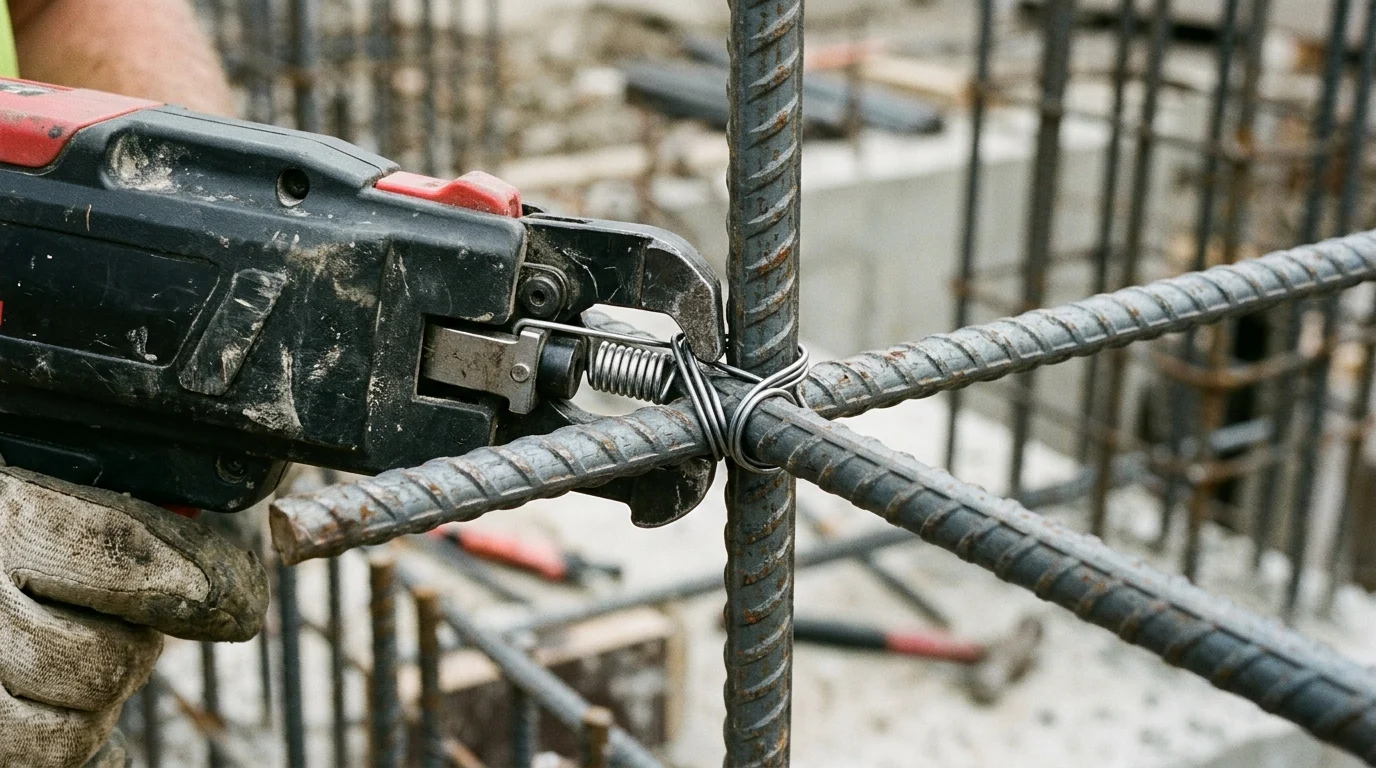
Transitioning from manual labor to automated equipment requires understanding the core mechanical principles at play. An automatic tier essentially takes the fragmented, multi-step process of hand-tying and condenses it into a single mechanical action.
Instead of a worker using both hands to manipulate pliers and wire, the automated tool handles the entire sequence internally. This shift from human physical exertion to mechanical precision is what unlocks the massive productivity multipliers seen on modern jobsites.
How wire feeding, wrapping, twisting, and cutting happen
The operational principle of a modern rebar tier is beautifully simple from the operator's perspective. You align the front jaw of the tool over the rebar intersection and pull the trigger once. Internally, a motorized feeding mechanism shoots the wire under the intersection, the wrapping gear loops it, and the twisting mechanism secures it.
This entire sequence—feeding, wrapping, twisting, and cutting—happens mechanically in a blistering 0.8 seconds. While real-world productivity must account for the operator moving and repositioning the tool between ties, replacing a 5-step manual process with a single trigger pull fundamentally changes the pace of reinforcement work.
How torque control improves tie consistency
Speed is only beneficial if quality is maintained, which is where the principle of torque threshold control comes in. Automatic tiers monitor the twisting resistance in real-time. Once the tension reaches a precise, pre-set threshold, the machine automatically cuts the wire.
This mechanism guarantees that every single knot is tightened with the exact same force. It completely eliminates the manual variations caused by operator fatigue, reducing the risk of a knot being too loose and causing rebar displacement, or too tight and snapping the wire.
Which performance definitions matter most
When evaluating this equipment, the performance definitions that matter most revolve around power, capacity, and maneuverability. For instance, operating on a robust lithium-ion platform ensures the tool has the sustained voltage needed to maintain its rapid mechanical cycle time consistently under heavy loads, without bogging down as the battery drains.
How to measure the productivity gain
The quantitative comparison between manual and automated tying is where the engineering gains become undeniable. By looking at the math, project managers can directly forecast how equipment adoption will shorten schedules and offset labor costs, provided the initial capital investment is justified by the project scale.
How to calculate time saved per tie
The basic math starts at the individual tie level. As established, manual tying takes roughly 5 to 8 seconds per knot. The automatic tier completes the mechanical knot in just 0.8 seconds. Even factoring in an additional second for the operator to step and reposition the jaw, the net cycle time hovers around 2 seconds per tie.
This means you are saving at least 3 to 4.5 seconds on every single intersection. While a few seconds might not sound revolutionary in isolation, it represents a massive multiplier in raw tying speed that drives subsequent project savings.
How manual and automatic tying compare over 1,000 ties
To see the real-world impact, we scale this up to a standard 1,000-tie benchmark. A manual worker, assuming they don't take breaks or slow down from fatigue, will take 1.4 to 2.2 hours to finish 1,000 ties.
Using an automated tier, factoring in realistic operator movement, those same 1,000 ties are typically completed in under 35 minutes (with the raw mechanical time accounting for just 13.3 minutes). The table below illustrates this contrast:
| Performance Metric | Manual Tying | Automatic Rebar Tier |
|---|---|---|
| Time per Tie | 5 - 8 seconds | 0.8 seconds (mechanical) |
| Time for 1,000 Ties | 1.4 - 2.2 hours | ~13.3 minutes (excluding movement) |
| Consistency | Highly variable (fatigue dependent) | 100% consistent (torque controlled) |
| Physical Demand | High (wrist/forearm strain) | Low (single trigger pull) |
Where high-volume reinforcement work sees the biggest gains
These quantitative gains translate into significant engineering benefits on high-volume projects like bridge piers, high-rise shear walls, or expansive tunnel linings. In these scenarios, a crew might need to execute 10,000 ties in a single shift. Reducing an 18-hour manual workload down to a fraction of the time completely changes project pacing, allowing subsequent trades to begin their work sooner.
Key rebar tier specifications to compare
To actually realize these productivity multipliers on a jobsite, you have to look closely at the equipment specifications. The engineering gains of an automatic tool are entirely dependent on its physical and electrical capacities, which must be weighed against its limitations.
Battery voltage, capacity, and runtime
The power source is the heartbeat of the tool. A standard professional tier utilizes an 18V 5.0Ah lithium-ion battery system. This high energy density provides a massive runtime, with manufacturers often claiming capacities of 4,000 to 6,000 ties on a single charge.
This allows a worker to get through a full shift without frequently stopping to swap batteries. Furthermore, the cordless design eliminates the tripping hazards of pneumatic hoses or power cords, allowing unrestricted movement on high-rise decks or deep tunnel inverts.
Tying diameter range and bar compatibility
Versatility is dictated by the tool's jaw capacity. A premium tier offers a tying diameter range of 6 to 58 mm (0.24 to 2.28 inches). Manufacturers note that this specific band covers up to 90% of the structural rebar specifications typically used in commercial concrete frames.
Whether you are tying thin stirrups or heavy threaded rebar for foundation mats, the tool automatically adjusts its torque output to match. This reduces the need to carry multiple tools for different bar sizes, streamlining the tool inventory.
Tool weight, ergonomics, and operator comfort
Finally, we must address the human element: weight and ergonomics. An optimized tier weighs around 6 kg (13.2 lbs). When combined with an ergonomic grip and a well-balanced center of gravity, this profile drastically reduces the physical toll on the operator's arms compared to manual plier twisting.
| Specification | Metric Value | Imperial Value | Engineering Benefit |
|---|---|---|---|
| Cycle Time | 0.8 seconds | 0.8 seconds | Significantly faster than manual tying |
| Tying Range | 6 - 58 mm | 0.24 - 2.28 inches | Covers most structural needs |
| Battery | 18V 5.0Ah Li-ion | 18V 5.0Ah Li-ion | High capacity per charge |
| Tool Weight | 6 kg | 13.2 lbs | Reduces operator fatigue |
Additionally, a short turning radius allows the tool to maneuver effortlessly through dense rebar meshes and tight beam-column joints where human hands struggle to reach.
When to choose an automatic rebar tier
Deciding when to deploy an automatic tier comes down to matching the tool's capabilities with your project's specific demands. While the quantitative data strongly favors automation, successful implementation requires a strategic approach that accounts for both the benefits and the drawbacks.
Best-fit projects and jobsite conditions
The best-fit projects for this technology are those with high-volume, dense reinforcement requirements. Precast concrete plants manufacturing PC components, pipe piles, or precast beams are perfect environments. The repetitive nature of precast work maximizes the rapid cycle time.
On active jobsites, bridge decks, tunnel inverts, and road mesh installations see immediate benefits. However, manual tying often remains preferable for highly irregular intersections, edge cases, or custom structural shapes where the machine's jaw cannot easily fit.
Rollout steps for wire, training, and maintenance
Rolling out the equipment requires a few basic steps. First, ensure you are stocking the correct gauge of proprietary wire spools designed for your specific machine, keeping in mind that these spools represent an ongoing consumable expense that exceeds the cost of standard bulk tie wire. Next, conduct a brief training session; operators need to learn proper jaw alignment to prevent misfires.
Maintenance is equally critical. These tools typically feature manufacturer warranties (often around 6 months) and are backed by factory mechanical test reports, but they are still susceptible to jobsite conditions. Keeping the feeding gears clean of metal dust, mitigating jamming in muddy or dirty conditions, and lubricating the twisting mechanism ensures the tool consistently hits its expected lifecycle.
Decision criteria based on productivity, quality, and cost
Ultimately, your decision criteria should rest on productivity, quality, and total cost of ownership. Project managers must weigh the initial capital cost of the machines and the ongoing expense of proprietary wire spools against the drastic reduction in labor hours. If your project schedule is tight and high-volume tying is a bottleneck, the transition to automated equipment is a fundamental modernization of the reinforcement workflow that quickly pays for itself.
Further reading:
Key Takeaways
- Measure manual tying first, because a 5 to 8-second hand tie can consume 1.4 to 2.2 hours for every 1,000 tie points.
- Use automatic rebar tiers on dense slabs, bridge decks, girders, and mesh work where thousands of repetitive ties create the largest productivity gain.
- Compare tools using cycle time, defect rate, labor cost per square meter, battery runtime, and wire consumption rather than purchase price alone.
- A 0.8-second tying cycle can turn rebar binding from a schedule bottleneck into a predictable production process on high-volume reinforcement jobs.
- Standardized mechanical tying helps reduce loose ties, broken wire, and quality variation caused by fatigue during long shifts.
Frequently Asked Questions
How much faster is an automatic rebar tier than manual tying?
Manual tying typically takes 5 to 8 seconds per tie, while automatic rebar tiers can complete a cycle in about 0.8 seconds, creating a major productivity multiplier on high-volume reinforcement work.
Why does manual rebar tying become inefficient on large projects?
The time compounds quickly across thousands of tie points, and workers slow down as wrist and forearm fatigue increases, making output less predictable over a full shift.
Does an automatic rebar tier improve tie quality?
Yes. Automation helps standardize wrapping and twisting, reducing variation caused by operator fatigue and improving consistency compared with fully manual binding.
What baseline metrics should contractors measure before switching tools?
Track average seconds per tie, loose or broken tie rates, labor cost per square meter, and daily tie volume to calculate realistic productivity gains and ROI.
Is the MAXMACH RT441 suitable for high-volume reinforcement work?
The MAXMACH RT441 automatic rebar tying machine is designed as a portable 18V Li-ion tool for repetitive tying tasks where speed, consistency, and reduced manual strain matter.